

A real life Zelig
…plus a smidgen of personal memories

The late Richard (“Dick”) Goodwin was a real life Zelig — though not in the sense of the character in Woody Allen’s film with that title.
Rather, Dick Goodwin was intimately involved in much of the history that unfolded during the 1960s.
Today, he would be labeled a social justice warrior.
This is a gallery of Richard Goodwin through his life. (No resemblance to Woody Allen’s Zelig.) He usually had a cigar in his hand.
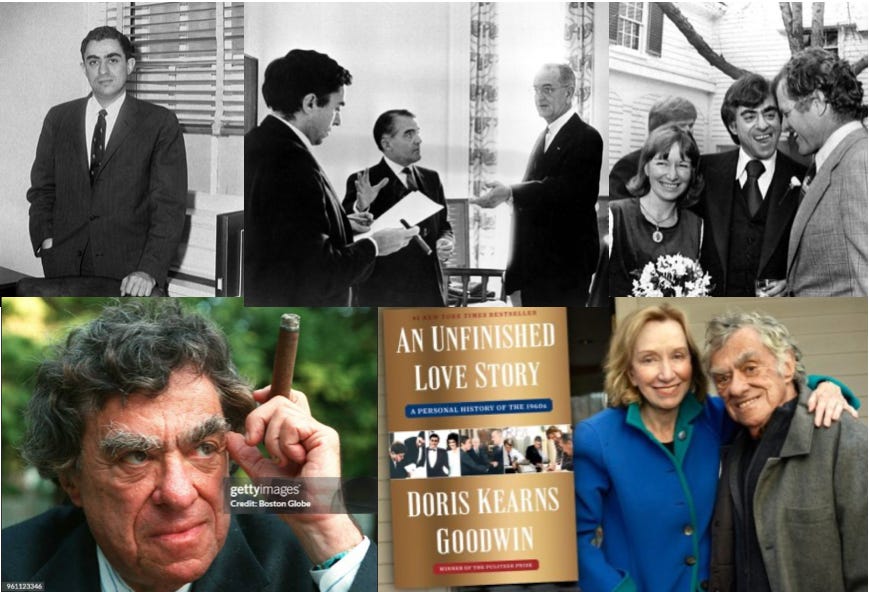
He was an inveterate collector of everything he ever wrote: journals, speeches, notes taken during meetings — plus photos and other memorabilia. All that material filled more than three hundred boxes — a treasure trove representing his long career — and those boxes were the source for Doris Kearns Goodwin’s latest book: An Unfinished Love Story: A Personal History of the 1960s.
The project of going through those three hundred boxes to determine what to include in a book required a lot of time — which, it turned out, Dick Goodwin didn’t have left. (Dick Goodwin was married to historian Doris Kearns Goodwin for 42 years until his death in 2018 after a short bout with cancer. He was 86.) Doris wrote this book after his death.
When my daughter first mentioned the title of Doris Kearns Goodwin’s book to me (it was released in 2024), I expected it to focus only on her marriage to Dick Goodwin. Then I saw the complete title and that completely changed the focus of the book — though it does somewhat touch on their life together. The reference to an ‘unfinished love story” is not with respect to their marriage so much as it is with their love (and aspirations) for our country.
It occurs to me that I was a witness, so to speak, to many events that Goodwin recounts —along with everyone else else who had access to the news on black & white TV or a print newspaper. (Remember those?) I had the Los Angeles Times delivered to my door step for decades, and I would read it while eating breakfast. The ink on the page was so fresh it would stain my fingers. A few years ago, I discontinued home delivery and switched to the digital issue.
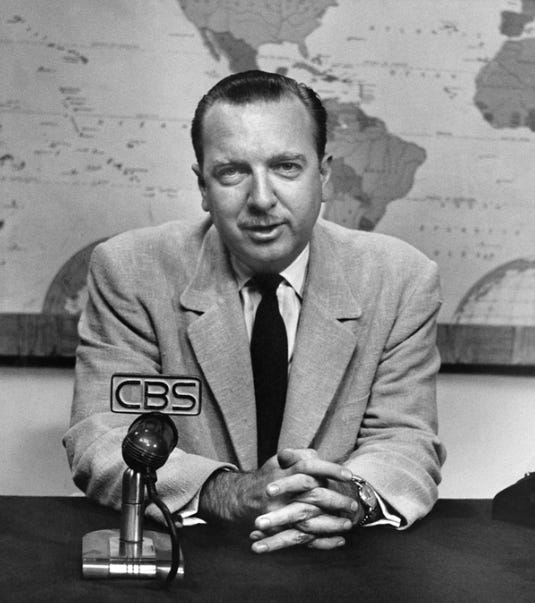
In the 1940s and ‘50s, we would have learned about current events by reading about them in newspapers. But TV was ubiquitous in the 1960s, so we were witnesses to those events, even if they didn’t occur in our backyard. Walter Cronkite was a nightly staple on CBS. (He was known as the “the most trusted man in America.”)
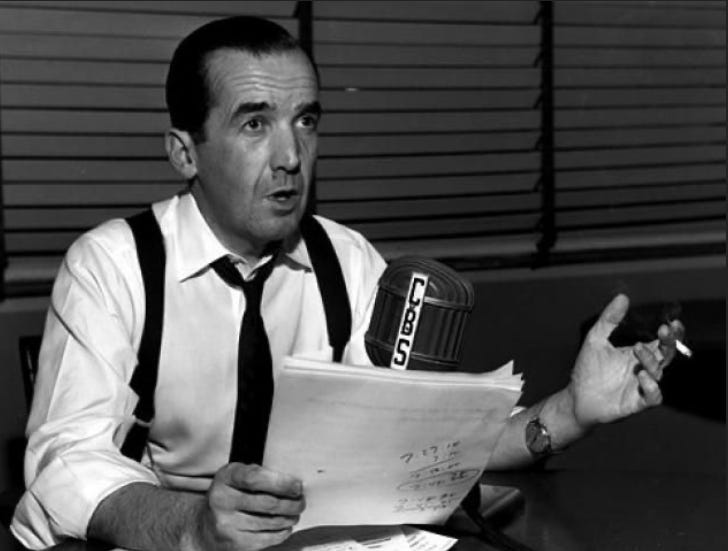
BTW, if you are ever in a trivia game and asked who was the CBS evening news anchor who used the catch phrase “good night, and good luck” to sign off, that was Edward R. Murrow. He smoked heavily and died relatively young at age 57.
So, for example, I watched the first televised presidential debate. Kennedy appeared to be cool, calm and collected — very presidential. Nixon was sweating and looked like death warmed over. I thought that Kennedy won the debate. Those who listened to the radio broadcast thought it was a tie.
In 1960, I happened to be in West Virginia on business in late summer when JFK was campaigning there. Some of the clients I visited told me that Joe Kennedy (Jack’s father) was throwing money around to buy votes for Jack. Given Joe’s less than savory reputation, that didn’t surprise me. But then I was told that Joe was buying votes with five dollar bills. Even given that a $5 bill was worth a lot more in 1960 than it is today, that struck me as nonsense. I didn’t pay any more attention to that bit of so-called “news.”
There was a television program on CBS during the ‘50s and ‘60s titled “You Are There.” it depicted network newsroom as being present and reporting on events in American and world history. Walter Cronkite was the host. His tag line at the close of each show was, “What sort of day was it? A day like all days, filled with those events that alter and illuminate our times...all things are as they were then, except you were there.”
So through television, I was a witness to multiple events in the 1960s: JFK’s election and assassination; Lyndon Johnson subsequently taking the oath of office; Jack Ruby killing Lee Harvey Oswald; the assassination of Martin Luther King; and the assassination of Bobby Kennedy.
And then came the 1968 Democratic Convention in Chicago. With Bobby Kennedy’s death, Dick Goodwin was supporting Eugene McCarthy in opposition to Hubert Humphrey (who ended up getting the nomination).
Doris writes that a one point, Chicago police raided the hotel in which McCathy supporters were staying. The police were hell bent on getting revenge against anyone that they regarded as flouting the law. They broke into rooms and herded McCarthy’s young supporters (who were largely college students in their early twenties) down to the lobby. The police had no reason for their action; they were essentially an armed mob. Dick Goodwin was staying in that hotel, and he came down to the lobby to cool things off. The police recognized him, and realizing that the press would crucify them if they did anything stupid, so they quietly left.
The protests in the streets, which were actually pretty small in size, only lasted about seven days. That didn’t deter the police. Demonstrators, reporters, as well as innocent bystanders, were attacked with police brutality. The National Commission on Causes and Prevention of Violence subsequently described what happened as a “police riot."
I also had a near, front-row seat to the Watts riots in 1965, so to speak. My wife and I with a two-year old daughter were living in an apartment that was about three-quarters of a mile west of Crenshaw Blvd., which was the western edge of the curfew zone. On the west side of Crenshaw at what was then named Santa Barbara Blvd. (Since renamed Martin Luther King Blvd.), was an outdoor regional shopping mall — the first one in Los Angeles. There was a Broadway department store on one corner and a May Company across the street, with numerous small, independent shops scattered around the complex.
When shopping at that mall, we would see Los Angles police officers and National Guard troops patrolling on foot. My morning commute took me along Crenshaw Boulevard. Several times I passed National Guard jeeps patrolling almost Crenshaw; a fifty caliber machine gun was mounted on the back of the jeep with a trooper sitting behind it. Numerous store fronts along Crenshaw were boarded up. My brother was in the National Guard at that time and had been mobilized; based on what he subsequently told me, I doubt that the machine gun was loaded with live ammunition. Nor did any of the National Guard troopers carry loaded rifles or side arms. The reasoning was that the troopers were not trained for crowd control, so the authorities didn’t want some nervous trooper over reacting. Also, as I recall, troopers were always accompanied by a LAPD officer.
(That is not what happened at Kent State, but more about that in a moment.)
This is an aside that has nothing to do with Dick or Doris Goodwin. It’s a tidbit I picked up during one of Professor Heather Richardson’s online chats. Have you heard of signing statements? George W. Bush (#43) used — abused is more like it — these statements. A president doesn’t have line-item veto authority. So when signing a bill into law, he would append a signing statement essentially putting Congress on notice that he wasn’t going to enforce some aspect of that law. This has no legal standing so far as I know, but Congress never pushed back. Here’s the kicker. Guess who first promulgated this use of a signing statement? He’s now an Associate Justice on the Supreme Court. But back in 1981, he was a young lawyer in the Justice Department. Yeah, this guy: Samuel Alito. (If Hell were a real place, I would nominate him as an occupant at the drop of a pin.)
Dick Goodwin didn’t follow the usual path to a law degree. After graduating from Tufts University (summa cum laude and elected to Phi Beta Kappa, no less), he enlisted in the U.S. Army and served in France as a private. After his enlistment was up, he went to Harvard, obtaining his law degree and passing the Massachusetts bar in 1958. Along the way, he became president of the Harvard Law Review. (A position that Barack Obama later also held.)
On side note, Ruth Bader Ginsburg was at Harvard Law with Goodwin. She was also on the Harvard Review with him. She was married at the time and he took steps to lighten her writing load when he could.
After passing the bar, Goodwin then became a clerk for Supreme Court Associate Justice Felix Frankfurter, who was an advocate of judicial restraint. Dick was an idealist and activist and felt that the Court should likewise be more activist. Frankfurter taught Dick otherwise as he recounted to Doris.
"His Socratic method was to draw me out, to challenge me, to encourage critical thought. He was a great and a crafty teacher. Maybe the best I ever had.
"Regularly, he cautioned and instructed me about the role of the court. And regularly, he throttled my activist approach to court decisions. He was constantly worried that if the justices imposed their own social or political views, the authority of the court itself would be chipped away. His institutional conservatism left a permanent mark on me.
"Our job is to enforce the law, including the Constitution, the Justice repeatedly said. 'We have nothing to do with your abstract notions of justice or liberty. Only with what the law provides. Trample the law for your own ends, Dick, and the time will come when you'll be trampled under someone else's ends.’”
Frankfurter would be aghast at the rulings the Robert’s court has handed down in recent years.
In 1960, Dick Goodwin was recruited as a speech writer for John Kennedy’s presidential campaign. Subsequently, Dick worked within the Kennedy administration. Then JFK was assassinated, and Goodwin found himself working closely with Jacqueline Kennedy to orchestrate part of the ceremony that we all watched unfold on TV.
Goodwin had no intention of joining Johnson’s administration. Dick was intensely loyal to the Kennedy family. He had observed close at hand the animosity that Robert “Bobby” Kennedy Sr. had for Johnson. (Bobby, to his discredit, was so jealous of protecting John’s legacy that he didn’t want any credit accruing to Johnson’s benefit, even when it was Johnson who drove through some of the social legislation that had been proposed by JFK.)
But Johnson recognized Goodwin’s unique talents both as a source of thinking-outside-the-box ideas and framing those ideas into speeches. Dick had an exceptional talent for forming a speech into the cadences of the individual who would be delivering that speech. So Johnson turned on the charm, and Goodwin joined his administration.
Goodwin was key in framing the speeches and ideas that promoted the Great Society and other domestic programs. Then the political turmoil between South and North Vietnam escalated. Johnson was well aware of the danger this conflict posed to his administration. (Goodwin privately worried that Vietnam could derail domestic progress.)
Johnson was well aware of the debate over the question — Who Lost China? — which had started in 1949 when the Chinese Civil War was won by the Chinese Communist Party. The United States had supported the Chinese Nationalist Party known as the Kuomintang, led by Chiang Kai-shek. (Chang had really been not much more than a corrupt Chinese warlord, but he was anti-communist. So the U.S. bet on the wrong horse for idealogical reasons.) The loss of China blame game was still alive and well into the 1960s.
Shortly after assuming the presidency, Johnson granted an interview to Jack Knight of the Knight-Ridder newspaper chain. In the interview LBJ posed this question: “What do you think we should do in Vietnam?” He then outlined the no-win options starting with this one: “One is to run” from the conflict “and let the dominoes start falling over. And, God Almighty, what they said about us leaving China would be just warming up compared to what they’d say now.”
This debate over the loss of China had endured in large part because of Senator Joseph McCarthy’s demagoguery against Americans he accused of collaborating with Communist powers — McCarthyism. Another factor was that during the early years of the Cold War, many American policymakers viewed other nations as pawns on a chessboard. The U.S. should pick the pawns worth saving, then, in so far as possible, move them to their advantage. Many policymakers did not question the hubris behind this assumption of American invincibility until the war in Vietnam grew into a long, costly failure.
So Johnson’s choices, as he saw them were:
Try for victory by invading North Vietnam, which is what the Joint Chiefs wanted;
Hold the line pro tem with the “see-how-it-works” — involving a force of 100,000 men to test how American troops would perform. This is what Mac Bundy and most of the second-level civilians wanted.
“Head for the exit” with some sort of Geneva negotiation as a fig leaf — the plan favored by Senate Majority Leader Mike Mansfield and Under Secretary of State George Ball.
Then there was General Westmoreland’s plan; he wanted to field 44 battalions, with a continuing buildup as needed thereafter, and new rules of engagement. (The gung-ho approach.) Basically, Westmoreland was proposing to turn Vietnam into an American war. His proposal would have also required Congressional authorization of a supplemental appropriation, and a tax increase to finance the expense of expanded military operations. Then there was the issue of how to sell this to the American public. That would burn through a lot of political capital and might upend support for domestic programs.
Johnson took none of these approaches. Instead he adopted what might be called “Westmoreland Light” — increase American boots on the ground, though not to the level requested by Westmoreland, and pretend nothing had changed — not go to Congress for authorization and not level with American citizens. This decision ultimately bit LBJ in the ass.
“Hey, hey, LBJ, how many kids did you kill today?”
Eugene McCarthy stunned Johnson in the New Hampshire primary, but then flamed out. Bobby Kennedy had been dithering about whether or not to challenge Johnson, but finally decided to throw his hat into the ring. And Dick Goodwin joined Bobby’s campaign. Dick was at home with the Kennedys once more.
Then Walter Cronkite visited Vietnam, came home, and on February 28, 1968 opined that that the conflict was destined to end not in victory, but in a stalemate.
Johnson could read the tea leaves, and so on a Sunday evening in March of 1968, he shocked the nation with this televised announcement:
“Accordingly, I shall not seek, and I will not accept, the nomination of my party for another term as your president.”
Bobby blew out the California primary in June, 1968 and was assassinated in the kitchen of the Ambassador Hotel.
(It’s hard to believe that RFK, Jr. — “worm-brain” — is Bobby’s offspring. Worm-brain is an acorn that fell far, far from the oak.)
Hubert Humphrey was named the Democratic nominee at the convention in Chicago and went on to lose to Richard Nixon.
Goodwin was now politically adrift and became more vocal in his criticism of U.S. involvement in Vietnam. The reaction from those who had originally promoted the Americanization of the war — and continued to do so — took Dick by surprise. Administration insiders started to attack the loyalty and patriotism of anyone who didn’t support the ongoing war. This is what Dick recounted to Doris and she records in An Unfinished Love Story:
"I was floored," Dick told me, "when Averell Harriman confronted me at Bobby's house."
"You and Schlesinger are murderers, he flatly accused me, 'you're killing American boys.
"I tried to calmly explain to him that exactly the opposite was true. We were trying to stop the killing."
"You're just encouraging Hanoi," Harriman charged, his voice growing shrill. "All this protest just makes them think we're going to give up."
"In an earlier time," Dick told me with more seriousness than I am comfortable with, "I would have challenged him to a duel."
Doris goes on to further recount Dick’s reaction.
Dick was further enraged when Dean Rusk assailed "pseudo-intellectuals who had served under JFK and LBJ and are now in dissent over Vietnam.” Words such as "traitor," "unpatriotic," and "disloyal" were bandied about. Dick had prepared his essay on loyalty to counter such charges. "Where to stand" had ceased to be an issue for Dick; exactly what to do and how to do it was now all that mattered:
"The government of the United States is not a private club or college fraternity. Its policies are not private oaths or company secrets. Presumably a man enters public life to serve the nation. The oath taken by every high officer of the nation, elected or appointed, is to support and defend the Constitution of the United States, not an Administration, a political party or a man.
"Dissenters are sometimes accused of demeaning the presidency. That office should demand respect. Its dignity, however, flows not from private right or title or the man who occupies it, but solely from the fact that its occupant is chosen by the people of the United States. It is their office, and if they, or any among them, feel that it is wrongly used, then it is their obligation to speak.”
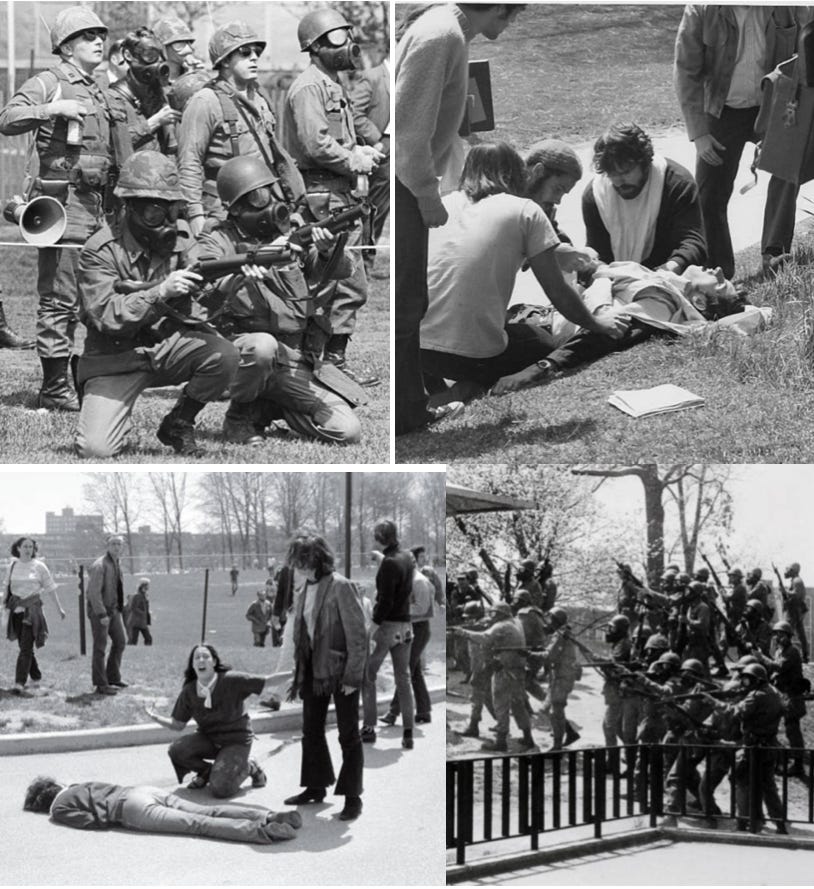
The protests against the Vietnam War continued after Nixon took office. In May of 1970, a protest erupted on the campus of Kent State University in Ohio. The Ohio National Guard was sent in to quelle the protest. The Ohio troopers were no better prepared for crowd control than had been the California troops. Unfortunately, the Ohio troopers were sent in loaded for bear. When tear gas didn’t stop the protesters, the Ohio troops opened fire, killing four students and wounding nine more. None of the students were armed. This became known as the as the “Kent State massacre” or “May 4 massacre.”
A quick digression. Doris Kearns had been pulled into Johnson’s orbit when she worked as a White House Fellow. She subsequently returned to Harvard where she taught government. After Johnson retired, he once more pulled her into his circle; he brought her to his ranch and enlisted her assistance in drafting his memoir. This led to her subsequently writing a biography of LBJ titled “Lyndon Johnson and the American Dream.”
Then, on page 212 of An Unfinished Love Story, I came across this observation by Doris Goodwin that resonated with me.
“At the time I hardly realized what a remarkable opportunity this was for me— still in my twenties, fresh from earning a doctorate in government and teaching a course on the presidency-to spend my days as the sole student listening to the real thing, the greatest presidential practitioner of the legislative process in the last half of the twentieth century. He [LB Johnson] was without a doubt the most overwhelming teacher of government I had ever had.”
Doris then recounts this observation by Johnson:
"There is but one way for a president to deal with the Congress, and that is continuously, incessantly, and without interruption. If it's really going to work, the relationship between the President and the Congress has got to be almost incestuous. He's got to know them even better than they know themselves. And then, on the basis of this knowledge, he's got to build a system that stretches from the cradle to the grave, from the moment a bill is introduced to the moment it is officially enrolled as the law of the land.
"A measure must be sent to the Hill at exactly the right moment, and that moment depends on three things: first, on momentum; second, on the availability of sponsors in the right place at the right time; and third, on the opportunities for neutralizing the opposition. Timing is essential.
"Momentum is not a mysterious mistress. It is a controllable fact of political life that depends on nothing more exotic than preparation.”
A master class in the political process by a man who understood the art of “sausage making.”
So I was cruising through the ‘60s with Doris and Dick, but it wasn’t until I got to the point where she describes LBJ’s death that it really hit me that I was a silent witness to everything she recounts because of TV. I undoubtedly read the paper (and probably magazines as well) about JFK’s assassination, then King’s murder, followed by RFK’s murder, then the 1968 convention, but it was watching it all play out on TV that gave everything immediacy.
I began to wonder where in the narrative of the ‘60s Doris would end this book. I didn’t expect her to jump ahead multiple decades to Dick’s last days. Even though I knew that Dick Goodwin died before Doris started work on this book, those last few chapters were tough going. I had a visceral reaction as if I had lost a friend. Doris describes his last month in this fashion:
One spring morning in 2016 I found Dick mumbling and grumbling as he worked his way along the two-tiered row of cardboard boxes in his collection. "Look how many boxes we have left," he exclaimed, pulling an unlit, well-chewed cigar from his lips and waving it over the boxes.
"I guess we'd better pick up our pace," I offered.
"You're a lot younger than me," Dick said. "Shovel more coal into our
old train and let's go!"
This determination to steam ahead had only increased with the approach of his mid-eighties. Dick scoffed at his wheezing and coughing, insisting once again that it was only allergies and spring pollen. Nevertheless, shortness of breath made for long pauses when climbing stairs. Recently, he had taken another fall on the gravel path while inspecting the forsythia, telling me as he scrambled to his feet that it was not a fall, but a slip, like a boxer trying to convince the referee it wasn't a knockdown.
"Who would you bet on?" he asked me one night at bedtime, nothing particularly morbid in his tone. "Who will be finished first: me or the boxes?"
Dick was finished first. During his last days, he seems to have engaged in a bit of magical thinking. He insisted that his doctors communicate with Doris about his health and exhibited little curiosity about what was happening to his body. It was his way of maintaining a positive attitude, as if ignorance could hold the grim reaper at bay. He took his meds but didn’t want to know what he was taking or why. Finally, Dick was placed in hospice in their home. Doris recounts Dick’s end (and closed her book) with these words:
“As the end drew near, Dick seemed very tired. He sweetly grasped my hand in his and put it on his heart. ‘You're a wonder,’ he rasped, his eyes shining with an uncanny light. It was the last thing he said to me. He squeezed my hand, then passed into a luminous state that seemed to straddle this world and the next. And that was all.”